A film review by Aryan Victor
M, a German thriller film , was released in 1931 and the director of the film was Fritz Lang . The film starred Peter Lorre as the troubled serial killer and revolves around the actions done by him. The film is about the hunt of the Serial killer of children by both the police and the criminal underworld .

The first scenes of the film starts slow where a group of children are playing and reciting the words to some poem about murder , while a mother doing her chores after hearing the children goes to the balcony and scolds the children playing about reciting the dreadful poem . One mother’s child, Elsie, strides down a public street while bouncing a ball. Her path is obstructed by a newspaper and the camera zooms in sharply as we see the words of a wanted poster and though it , we are exposed to the current situation of the area where it warns us of a child murderer stalking the city. Then the shady silhouette of a man in a hat passes over the poster, staring down at the little girl who has bumped onto him “accidentally”. “That’s a nice ball you have,” he says but we are not shown his face. The film cuts back to Elsie’s mother preparing food and waiting for her to return home while the murderer talks with Elsie, gets her a balloon, and whistles a tune (which holds a great significance in the narrative ) . Time and quiet pass on, and the girl does not arrive home like her little friends do. The mother calls for Elsie worrying for her child’s safety and her lonely efforts are shown where she is calling her out in an empty staircase where her voice echoes. Her ball is seen blowing in the wind, and the is balloon caught in the power lines signifying that the murder has taken place and Elsie is dead.
The city is overwhelmed with fear . Many murders have already taken place, and the murderer is still on the loose . The local newspaper prints a letter they believe has been written by the murderer, and a handwriting expert analyses its details in an attempt to find him to put an end to his activities . In the film the motives of the murderer are not entirely clear, but his thirst for murder is irresistible and he can be seen in physical pain when that thirst is not fulfilled , and in a later scenes we can see that he gets relief by spying on a little girl and putting his plan to fruition .
His existence acts as a triggering point of various people . The police want him caught for the sake of easing the pressure put on them by the society. Citizens want him caught so they no long have to worry about the safety of their children . The criminal underworld, meanwhile, wants to eliminate him as due to the murderer the police have become ever more attentive and their own activities are being harmed due to this and killing small children is even against the morals of the criminals . As the film progresses the police is slowly taken away from the mix in order to drive the presence of the underworld into action because if the murdered is not eliminated they themselves cannot conduct their own practices .

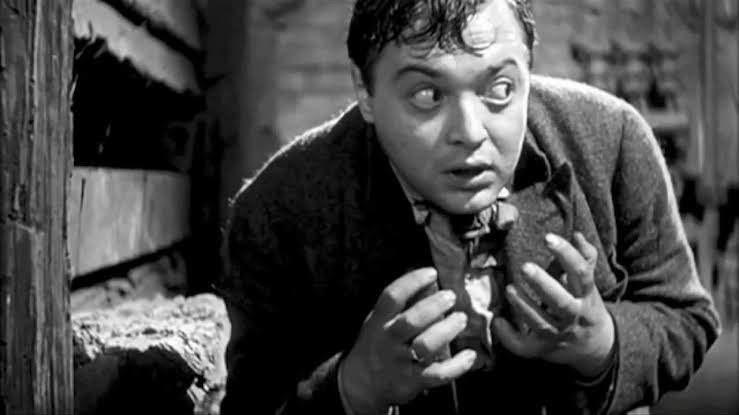
The role of the murderer named Hans Becker is played by Peter Lorre who was a very famous actor at that time . His great acting creates a sense of duality in his character and brings out the pain and lack of freedom of him , we can see his angst emotions where he says , “I have no control over this, this evil thing inside of me,” . “The fire, the voices, the torment! It’s there all the time, driving me out to wander the streets, following me, silently. ”

The technical aspects are some of the most distinctive and exciting of any movie that i have seen of that era. There is dramatic and fast movements of shots , long takes and it is often shot from wide or high angles, and cameras moves along the character as a real life stalker . The film does a great job of creating empty spaces that emphasizes tension. A combination of shots from an interior of storehouse in which the murderer is “judged” by a jury of countless delinquents is brilliant where in one continuous take, for instance, the camera moves silently from one end of the room to next, revealing a series of stares that suggest the same sentiment where there is no sympathy to be had for a man who kills children . The film successfully creates underlying terror in the narrative. We can see sharp camera angles and irregular mannerisms in characters unable to hold back their motives , and body language that suggested eagerness . Their presence adds dynamic weight in the absence of sound.
The structure of the movie plays on the paranoia that was prevalent in German suburbs during the early 30s. The kind of story that M tells was not present as much at that time where it became an anchor point of German expressionism which was not interested in fantasies and anymore but focuses on the more real and gritty issues of everyday life .
The Lorre performance, as exaggerated as it might be , serves the purpose of the film greatly and shows the internal struggle of the character and asks the audiences to question their morals . the film creates an atmosphere where there is fear everywhere lurking around even though the one who is the root of all this fear is troubled himself . It creates a feeling of skepticism where the freedom of children is at stake due to such fearful environment and also question the audiences on the duality of the society .
 Site Title